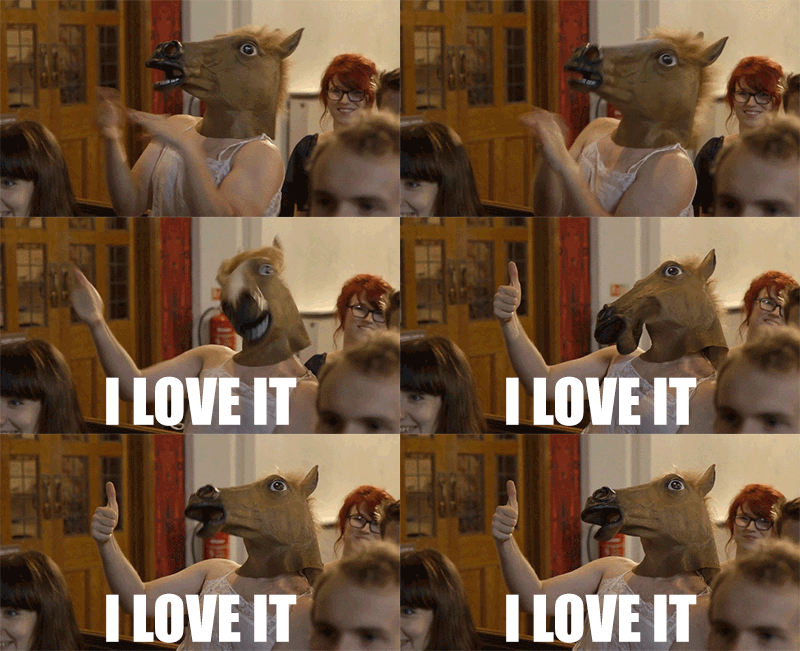
My Players: We must become friends with this person
Me: the blacksmith, a literal demon, takes a montrous bite from the whole pig in his hand.
My Players: we must adopt him. He is our uncle now.
Me: The hand is mummified and gross and undead, it tries to attack you because it used to belong to a murderer.
Party rogue: It’s my pet now and I will lotion it until it loves me.
Me: You are standing on a Rug of Smothering
Party Cleric: I’m gonna tear off a piece of it and keep it as a pet.
Update: They did, in fact, make friends and now half the party wants the Butcher to become a Demi-God
This is all very good and real, but I think you’re missing the most important part, which is when half of them decide on a whim to hurl Good King Lovespuppies out the nearest window
Party sees some monster: baby, baby boy
Party sees kind and benevolent npc: i dont trust like that
A dishonest man you can always trust to be dishonest, honestly. It’s the honest ones you have to watch out for, because you can never tell when they’re going to do something incredibly stupid. -Cpt Jack Sparrow
My players adopted a Goblin, an Owlbear and a Hobgoblin Vigilante, my Rogue went through the Monster Manual and made a list of things she wants to adopt. She wants a Gelatinous Cube but like, “a smol one” no Ranger I have ever DM’d for was this bad :))
THE MOST IMPORTANT RULE THAT SUMS UP ALL TEN: If it sounds like writing, re-write it.
1.Never open a book with weather. If it’s only to create atmosphere, and not a character’s reaction to the weather, you don’t want to go on too long. The reader is apt to leaf ahead looking for people.
2. Avoid prologues. A prologue in a novel is backstory, and you can drop it in anywhere you want.
3. Never use a verb other than “said” to carry dialogue. Because “said” is far less intrusive than grumbled, gasped, cautioned, lied.
4. Never use an adverb to modify the verb “said”… …he admonished gravely. To use an adverb this way (or almost any way) is a mortal sin. The writer is now exposing himself in earnest, using a word that distracts and can interrupt the rhythm of the exchange.
5. Keep your exclamation points under control. You are allowed no more than two or three per 100,000 words of prose.
6. Never use the words “suddenly” or “all hell broke loose.” This rule doesn’t require an explanation. Writers who use “suddenly” tend to exercise less control in the application of exclamation points.
7. Use regional dialect, patois, sparingly. Once you start spelling words phonetically and loading the page with apostrophes, you won’t be able to stop.
8. Avoid detailed descriptions of characters. In Ernest Hemingway’s Hills Like White Elephants what do the “American and the girl with him” look like? “She had taken off her hat and put it on the table.” That’s the only reference to a physical description in the story, and yet we see the couple and know them by their tones of voice, with not one adverb in sight.
9. Don’t go into great detail describing places and things. Long descriptions often bring the action and the flow of the story to a standstill.
10. Try to leave out the part that readers tend to skip. Think of what you skip reading a novel: thick paragraphs of prose you can see have too many words in them. In those moments, the writer is often writing for the sake of writing, perhaps taking another shot at the weather or going into the character’s head, and the reader either knows what the guy’s thinking or doesn’t care.
Very good rules. Except they can all be broken, and occasionally should be broken. Here are some examples that can help you identify when to break these rules.
1. Don’t open with the weather – unless you have a very good reason to do so.
For example, you might expect a funeral scene to be dark and dreary, overcast, even raining. But what if you open on a bright, sunny, summer day – with a group of people gathered in a cemetery wearing all black? That immediately subverts the readers expectations and creates an interesting dynamic. And of course, if the weather is very unusual or extreme, like a tornado hitting your MC’s house, that works too.
2. Avoid prologues – unless the prologue helps create an interesting dynamic or atmosphere, relays info that couldn’t be relayed any other way, or is in a different POV/setting/etc. than the rest of your novel.
Maybe your prologue reveals information that your MC wouldn’t or couldn’t know, but you want the READER to know that information to create dramatic irony. Maybe the prologue takes place 1000 years before the main story takes place. Maybe your prologue is like a mini “history lesson” that helps set up the atmosphere for the rest of the novel. A prologue isn’t always a bad thing – you just have to use prologues judiciously.
3. Said is dead – unless you use other, unobtrusive dialogue tags.
I’m really a fan of just using said. But sometimes, characters do speak in other ways. Don’t use something other than said just to create a more “dynamic” reading experience, but do use it if you really need to point out the way a character is speaking – for example, “he whispered,” “she murmured,” etc., are all fine and most readers won’t take much note of them, so it won’t pull them out of the reading experience like other dialogue tags might.
4. Don’t modify “said” with adverbs.
I’m mostly in agreement with this one, but the occasional modifier doesn’t hurt if you only do it occasionally, and to really highlight the way a character is speaking – for example, if it’s very unusual and doesn’t fit the actual words.
“He’s dead,” said James giddily.
5. Use exclamation points sparingly.
In total agreement with this one, unless you’re writing a book for small children.
6. Don’t use “suddenly,” etc.
In total agreement with this one as well, but I’d like to explain why it’s a bad idea. “Suddenly” is usually a form of telling rather than showing, and avoiding it forces you as a writer to describe the scene in more detail and actually show what’s happening.
7. Use regional dialect sparingly.
This is honestly something that comes down to readability. But in most cases you do want to avoid it, and especially avoid writing out accents, especially when this could be potentially offensive. My French friend absolutely hates “ze accent” used by Fleur Delacour in Harry Potter.
8. Avoid detailed descriptions of characters.
Again, in most cases this is true, but there may occasionally be a moment when it works to describe a character in detail. For example, if your MC is taking notice of a very odd or out of place character. Even here though, it’s best to pick out one or two striking characteristics. We don’t need to know every minute detail down to their hair color, eye color, height, weight, etc.
9. Don’t go into great detail describing places and things.
…unless it’s to create mood, to slow down pacing, to show that a character is fixated on something… This works best if the place or thing has a striking or unusual appearance, same as describing characters. And also like describing characters, it’s still best to pick out the most striking aspects appearance-wise of the thing you’re describing.
10. Try to leave out the part that readers tend to skip.
This is very good advice and I won’t touch it. I’ll just point out that the best way to find these sections is to reread your writing and take note of what you’re skipping as you reread.
In general, if someone tells you “it’s a mortal sin” to do something in your writing, then they simply aren’t a good enough writer to know when to use that tool appropriately
After all, Dickens does at least 80% of these Awful Things and he is considered Classic Literature
Most of these made me realise why I’ve only read one Elmore Leonard book…and I can’t remember which one it was…
Here’s the thing about writing, imo – you’re writing to tell a story that you imagined and brought to life with nothing more that sheer determination and lots of tears (probably. in my experience). no one is a perfect writer. writing trends come in and out of fashion. write what you feel like tell the story the way it’s meant to be told – talk to a beta or editor, get their opinions, learn and grow.
but a list on the internet isn’t going to make you into the next Hot Writer. it’s not going to get you on bestsellers lists, or find you an audience. you could follow every single rule about writing ever and still produce a pile of poo, because it isn’t YOURS. it’s what everyone else tells you is good.
some tips will strengthen your writing, absolutely! just like an artist doing sketches to try a new style, write up a short mock story using those tips – does it blend well into your own personality? do you feel like it makes a difference? does your editor/beta? if not, then, fuck it. do your own thing. build your own world.
The impact of gunpowder in combat formations and battlefield tactics in Europe
The Swiss Pike Phalanx became a popular formation around 1500, or so. Prior to that, medieval and renaissance armies (especially in central Europe) focused primarily on heavy cavalry and elite infantry. These usually consisted of nobles, and were supplemented by poorly armed peasant levies. Think Battle of Agincourt here, elite semi-noble and noble French troops against English peasants and nobles.
The Swiss relied on citizen armies, all armed to an adequate standard. And to maintain relevance on a battlefield dominated by heavy cavalry, the Swiss implemented a heavily modified version of Alexander’s Phalanx. By mixing in long-reaching melee units, the Swiss Phalanx was more maneuverable, more sturdy, and all around better than either Alexander’s armies, or the infantry forces which had preceded them. Especially in France, Swiss mercenaries plied their trade and dominated all comers for decades.
However, they were challenged by German mercenaries, who initially copied their style. The German Landsknecht was essentially a heavily modified version of the Swiss Phalanx. One of the major, early, innovations of the Landsknecht was the introduction of several different kinds of long, reaching weapons, including the famous Zweihander two-handed sword. These weapons, in either Swiss or German employ, were used to cut down attackers before they broke the Phalanx, as well as cut the heads off of the enemy phalanx before launching their own assault. The Germans increased the ratio of pike to other weapons, and made their formations more versatile.
However the crucial innovation, and the one which would spell the end for the dominance of the Swiss, was the Landsknecht’s willingness to accept gunpowder weapons into their forces. Early in the 15th and early 16th centuries, during the hay-day of the Swiss, gunpowder weapons were expensive and rare. Thus, the Swiss incorporated very little of this new technology. But the Landsknecht, iterating on the Swiss design, incorporated these new weapons on a much larger scale. They might have between 15-25% gunpowder troops, which far outnumbered the Swiss. This allowed the Landsknecht to harry, demoralise, disrupt, and weaken the opposition well before they could respond (especially if it was a Swiss unit facing them!). Yet the Swiss never really integrated gunpowder weaponry on the same scale as the Landsknecht. Part of it was that the two forces rarely met in battle, and part was that the Landsknecht quickly proved themselves the superior style of mercenary. Only France, due to the preferable terms the Swiss offered the French king, really clung to the older model of army, and with poor result! In the few occasions where Swiss and German met, the Landsknecht regularly proved their superiority, especially in terms of firepower.
However, by the late 16th century, both the Swiss and the Landsknecht would find themselves outclassed by a new formation, the Spanish abomination.
In many regards, the Tercio is weird. For most of human history, armies lined up in a roughly linear fashion to fight each other. The lines might look different, be different sizes, and have a different organisation, but the linearity of war has been relatively constant. The Tercio, on the other hand, rejected that. The Spanish formed their phalanxes into giant squares, surrounded by musketeers. Anywhere from 3-5000 men made up the formation in its initial incarnation, and three or four of these Tercios (as one block was called) would form a wedge or diamond on the battlefield. It would go forth, and smash huge holes in the enemy formation, while maintaining a steady stream of fire against all comers.
The Tercio had several advantages, which made it useful across the Habsburg domains (Spain and Germany mostly, though the Tercio would eventually travel to Eastern Europe and elsewhere). Firstly, the Tercio was easy to command. With all those men, packed tightly into a huge square, orders could be easily communicated. Next, the Tercio concentrated a huge number of men in one spot. At any given time, the Tercio could be confident that it could bring more men to bear than an enemy, arrayed in the classic linear fashion. Further, the Tercio (ideally) maintained a constant volley of fire whenever it moved against the enemy. Within that belt of musketeers, the men were arranged roughly into lines, or waves. As the Tercio entered weapon range, the first line would fire their weapons, then move rearward. The second line would fire, and also move rearward. The rear lines would reload, and when their turn came, also fire. Theoretically, this meant that the Tercio would always be shooting, and wearing down the enemy.
But the Tercio too had many problems. Its movements were sluggish, and clumsy. 3000 men are hard to move around, especially when the musketeers were performing their evolutions. And with precious few officers to control the chaos, even veteran musketeers found the Tercio difficult to handle. Further, when moving to the attack and defence, the pikemen of the Tercio had to somehow switch places with the squishy musketmen on the outside. Especially on the attack, when the pikemen had to leave their cocoon and push forward, those manoeuvres sowed chaos and confusion in friendly ranks. Further, because the Tercio was so big, the men in the center and rear were often deaf and dumb to pressing danger. Rather than run, they blindly pushed forward against the front ranks, who had no choice but to press on. In the early days, this made the Tercio seem invincible; this dynamic meant that the Tercios almost never routed. But too, this was a doubled edged sword. At Rocroi, the Tercios should have retreated when they had the chance. Instead, they were annihilated. And on the subject of men in the back pushing, the men behind the first few ranks almost never saw any action. Other than pushing forward, many of the Pikemen of the Tercio rarely contributed to the outcome of the battle. Unlike in a classically linear formation, the Tercio locked men away in tight blocks. It was a hugely inefficient formation.
Only the Spanish really ever employed the Tercio to its maximum effect. But, by the Thirty Years War and the Dutch Revolt, many European powers had solved the Tercio problem, and had again iterated with new tactics.
During the Dutch War, the Dutch found themselves fighting the Spanish Tercio. But they had a problem, many of the Catholics living in Southern Holland (modern Belgium) didn’t want to fight with Protestants, against their trading partners, at the risk of having their farms and estates burned. That left the Dutch without aristocrats, and in 16th century terms, that meant no officers! (Traditionally, the nobility served as the kings officer corps. They were appointed based on wealth and power, not merit. The Dutch had no king, and the nobles abandoned them. That meant William the Silent had to adopt a new kind of army to fight the Spanish).
If the Swiss solved the cavalry problem by harkening back to Alexander, then William the Silent went back to Caesar for his inspiration. The Dutch formed their army around citizen soldiers which were organised into centuries and cohorts, later companies and brigades. Each unit was organised in a standard fashion, and had a standard complement. That meant a general could always know exactly what 2 brigades meant, it was x number of pikes and x number of guns, and that helped the Dutch standardise their army.
In terms of unit composition, the Dutch also radically increased the numbers of muskets v. pikes, to perhaps 30-40% of their army. They arranged these units in a roughly Roman formation (that classic checkerboard), with each brigade alternating:
Pike-Shot(gun)-Pike-Shot-Pike-Shot, etc.
In combat, the musketeers would soften the enemy up (either on the offensive or defensive) while the Pikes would manoeuvre into position. At the critical moment, the pikes would rush forward and attack the enemy, or defend the musketeers (who would retreat and seek a new firing position).
But the innovation was incomplete. It would take a Swede, Gustavus Adolphus, to carry the new formation into its final form. Prior to 1630 and Sweden’s entry into the Thirty Years War, Adolphus had waged a long war against Poland. Poland fought wars radically differently than the central and western Europeans: they relied more on peasant levies, pure pike armies, and the legendary heavy cavalrymen, the Winged Hussar. In Germany and France, the Swiss and Landsknecht had killed the heavy, lance-armed, cavalry which had dominated the in the renaissance. Instead, cavalry fought much like musketeers did in the Tercio.
The Caracole manoeuvre had cavalry charge the enemy and, at the last
second, fire a pistol or carbine before turning away and riding back to
the rear to reload. Both complicated and ineffective, the weapons of the time, fired from horseback, simply could not reliably produce the damage and confusion required to break an enemy. But the charge of a Hussar, with their heavy wooden lance, could do just that. Adolphus adopted the Hussar, and used it as his corps of decision. When he was ready to end a battle, he would launch his Hussars at the enemies’ weakest point, where they would have the worst possible chance of stopping the heavy cavalry. And, once broken in one spot, the enemy army often quit the field in whole cloth.
Adolphuses other innovation was much simpler. He designed and employed a series of light artillery pieces, and gave them to his individual brigades. While they were inaccurate and often inefficient, no other army had given control of the precious artillery pieces to smaller units before. The Adolphan brigades thus had a lot more firepower than their opponents did, and the Tercios did.
Adolphus brought his new army into the field against the Austrians, who had adopted Spain’s Tercio. But the Austrians had never mastered it, and found themselves repeatedly checked and defeated by Adolphus. It signalled a paradigm shift, and many European armies (especially among the protestants) adopted the new style. Even France switched to this new model. And at Rocroi, when the veteran Spaniards met the new French armies in battle, the Tercio was finally broken, and the cream of the Spanish army was laid to waste. This new model would persist, with some modification, into the reign of Louis XIV.
The central concepts, heavy cavalry, brigadisation, and a mixture of pike and shot, would be adhered to until after the War of the League of Augsburg, when socket bayonets replaced the Pike. Yet, even before then the ratio of Guns to pikes continued to expand. During Adolphus’ lifetime, his army likely grew to around 50-60% guns. By the W. O.T. League of Augsburg, that ratio was around 75%. And obviously, by the W. O. Spanish Succession, just a few years later, that ratio had grown to nearly 90-100% (with the bayonet).
This is the general flow of battlefield tactics in the Early Modern Period. The real secret to warfare during the 16-18th century was the gun. Each formation successively brought more firepower to bear than the last one. Guns were useful in many situations, both on the attack and the defence, but the Pike was only useful as a weapon of last resort (ie, close-in fighting) and as a last shock action to cement a victory and route the enemy. The formations which brought more gunpowder to bear did better than those that incorporated less. And this arms race would continue into the early 1700s, when armies finally adopted the socket bayonet, which turned guns into makeshift pikes, and finally made armies 100% gunpowder affairs.
The other day my mom said something that i found really insulting to
the 2d animation movies, she said that they stopped doing those because
they were no longer appealing to the audience and that they were
supposed to be discontinued, and i just thought how bullshit of an
argument that is.
Comparing 2d animation with 3d and saying one is
superior is like saying that digital art is better than traditional
art, better than the fucking Mona Lisa, The creation of Adam, in fact,
is a pretty ignorant comparation to do because one does not suprass the
other, but new techniques are getting invented and we invest in those
more.
Is just another way of animation, in fact, the shitty move
all those studios did by closing their 2d animation studios eas
pointless and it´s gonna cost them greatly, because someday people are
gonna want to go back to the 2d animation and studios like Disney or
Dreamworks will be too scared to do that, that will be the day that
other studios will take upon them and give us what we want.
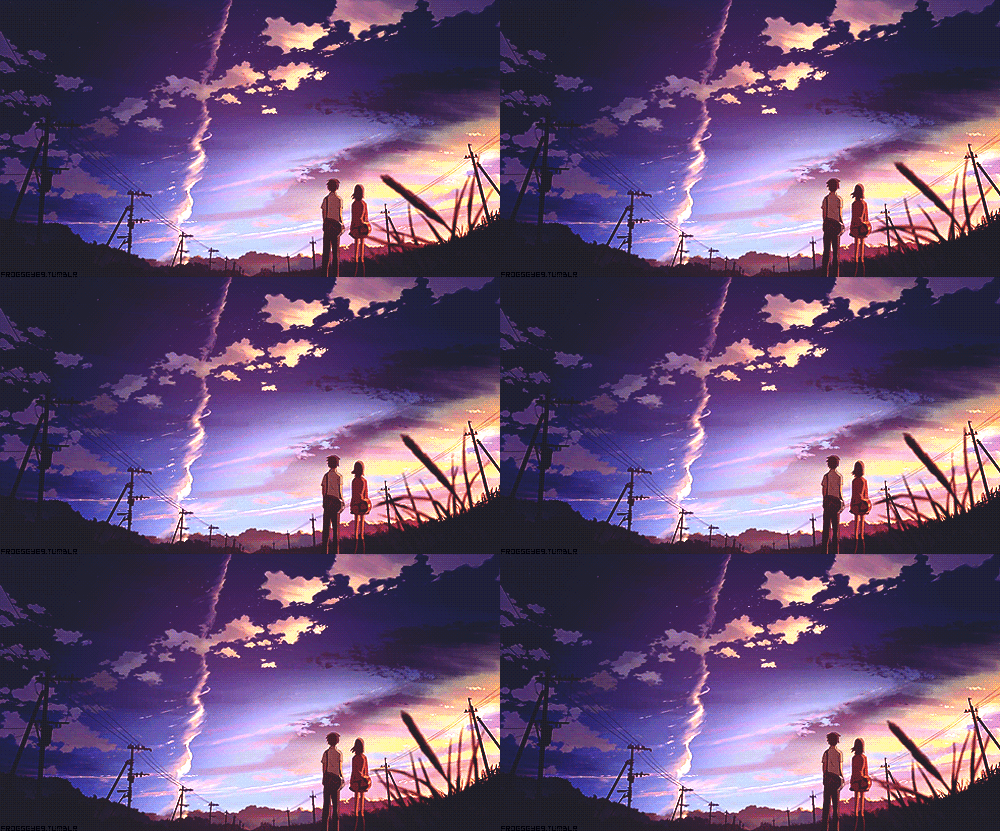
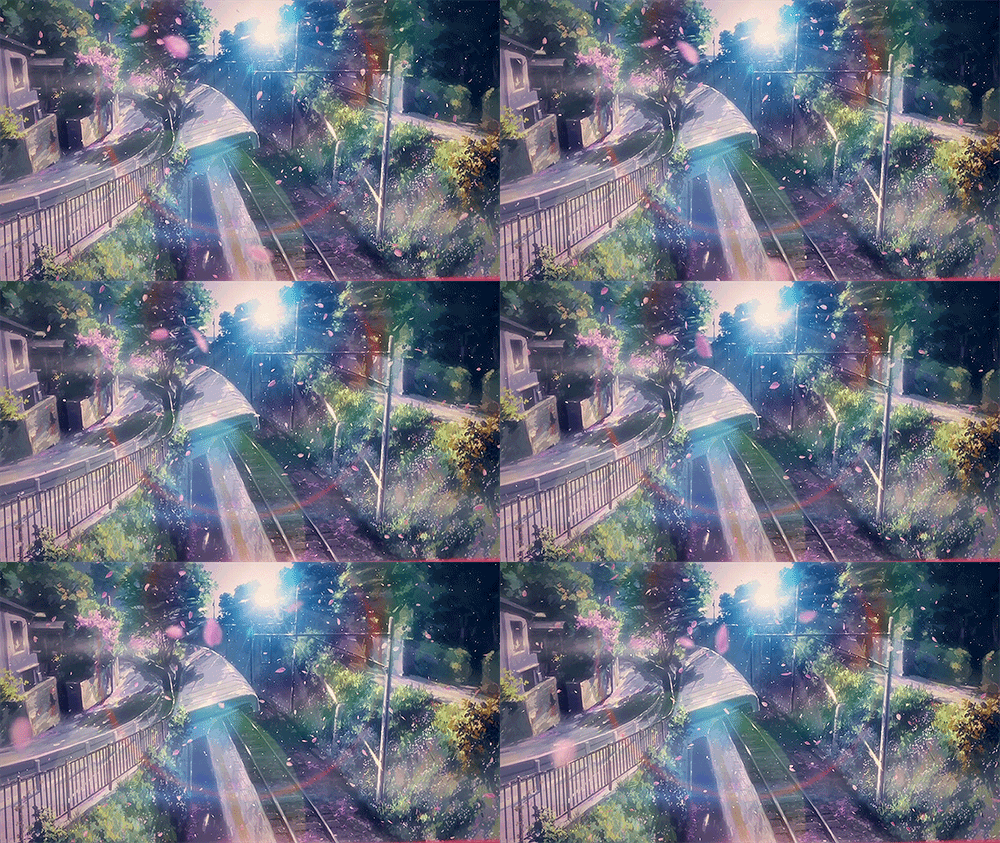
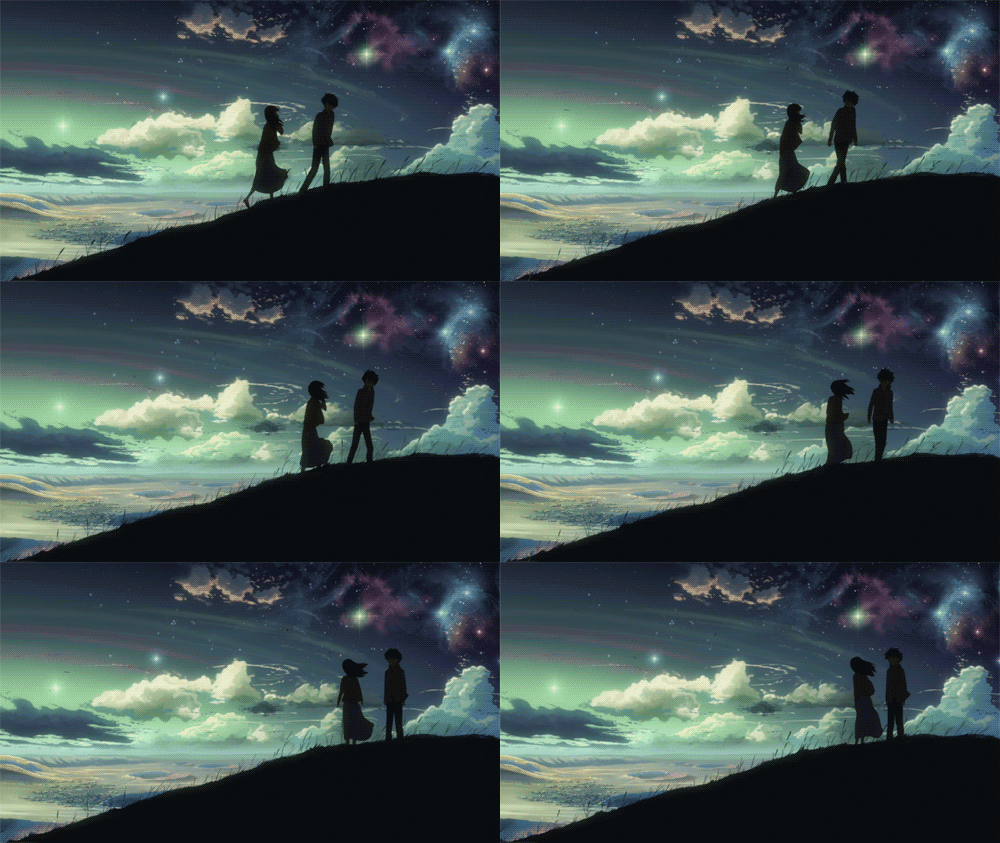
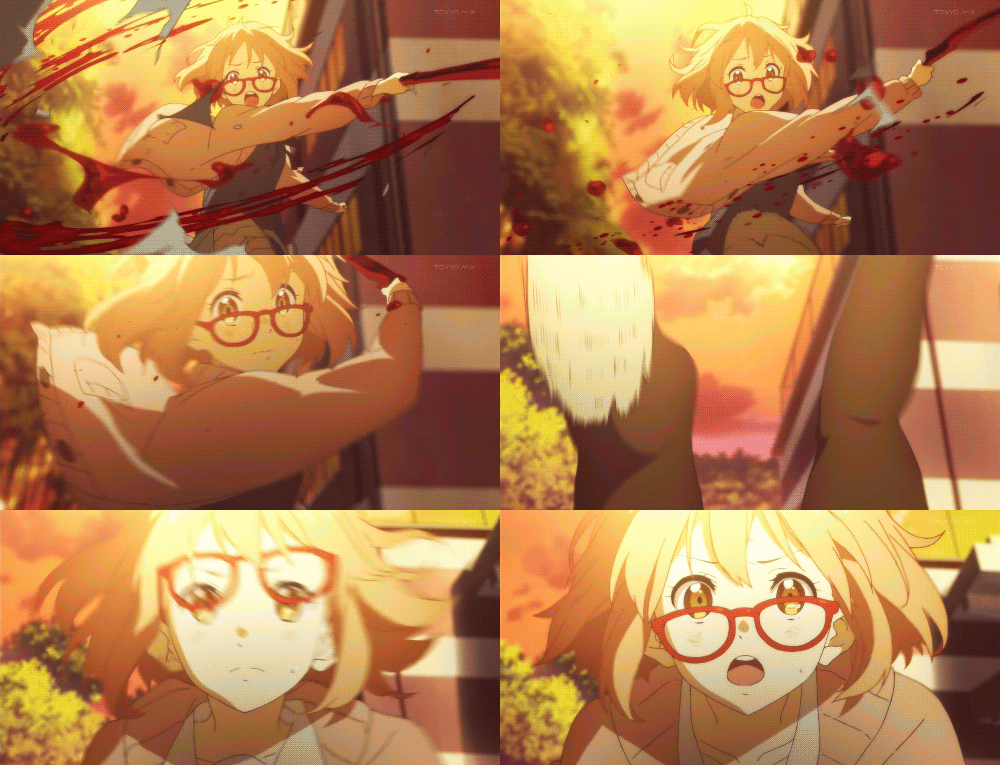
2D animation has the most beautiful animation i´ve ever seen, there´s something in it that i can´t explain that makes a big difference from watching cgi, and what i think would make a great combination is the great amount of details that you see in CGI and 3D movies into 2D techniques so you could expect to see shit like this
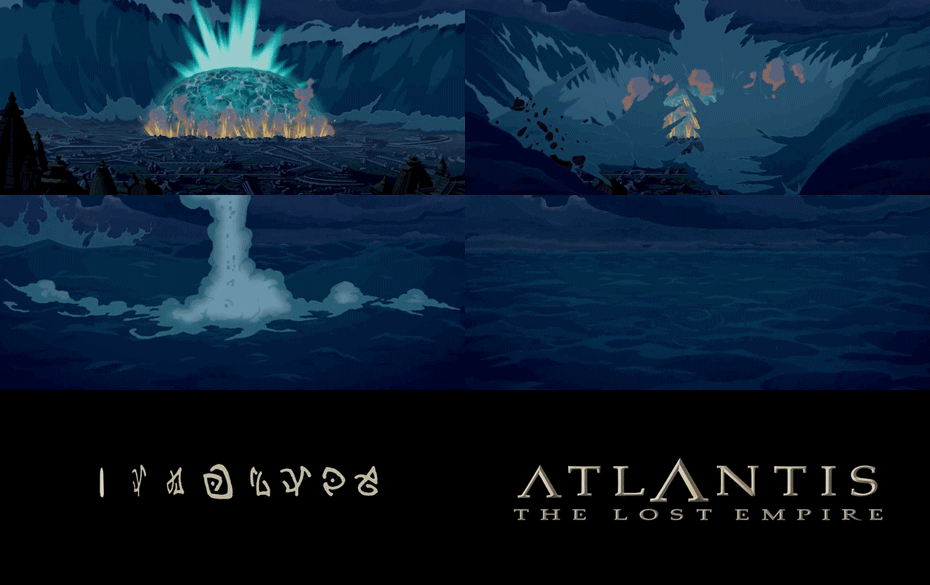
Atlantis (2001)
Treasure Planet (2002)
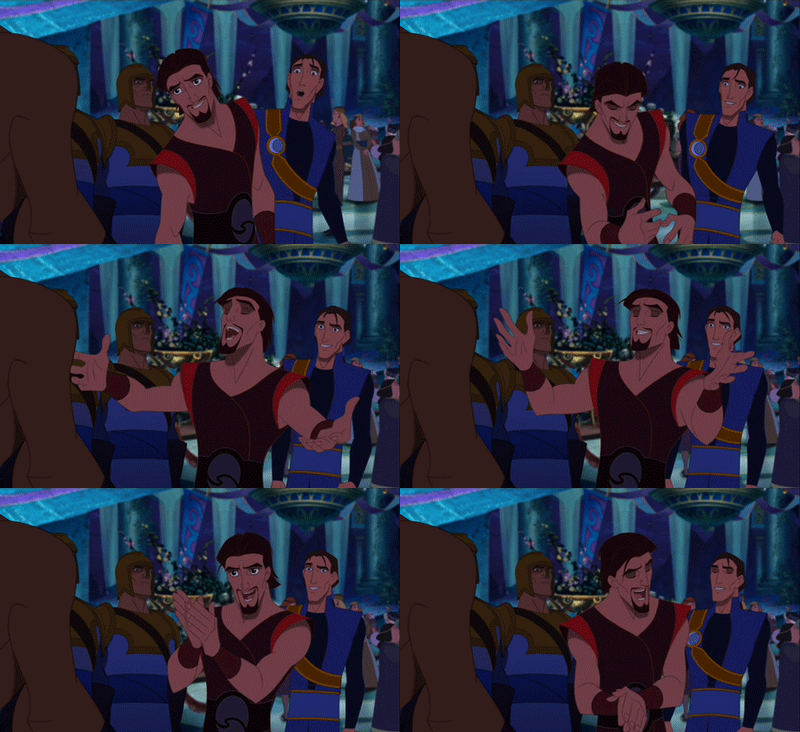
Sinbad (2003)
5 centimeters per second (2007)
The princess and the frog (2009)
Children who lost their Voices (2011)
Beyond the boundary (2015)
Your name (2016)
So whoever dares to say 2d animation is dead is wrong and also a bitch
Most of the disney ones you pointed out have some elements of 3d in them. Or rotoscopped from 3d models in the case of sinbad. As for the anime It could be a toss up. I don’t watch too much anime from the current stuff but I think they kinda use some bits of 3d as well. But I could just be talking out of my ass.
the reason why 2d animation in feature is practically dead in the west is because the animation giants here all figured out that 3d animation if far cheaper to produce than 2d. and that same reasoning is how you end up with reused models. (its why we’re getting live-action remakes of classic 2d movies. it why we’re getting more sequels than we are originals)
its cheaper.
thats why, short and simple. 2d animation is expensive as all hell to make. and for companies like disney thats all theyll ever care about.
I hate that coming out is like, entirely for the sake of cis&straight people. We come about because they can’t stop assuming that everyone else is cis&straight, we come out because they can’t stop being homophobic and transphobic and assuming that we are comfortable hearing it, we come out because they keep asking about why we don’t have a boyfriend yet or monitoring which bathroom we use. And then there’s the fact that cis&straight people are so invested in us coming out. They tell us it’s lying and deceptive when LGBT folks don’t come out to the point that they tell other people for us, they tell us that they “already knew” or “could tell” and brag about their gaydar or else they praise us by pretending it’s a compliment that they “never would’ve guessed”, then they go on to call us “brave” and “strong” for doing something we never should’ve had to do in the first place. And then there’s the idea that we are the ones who should feel ashamed about it and be told that they “still love us” despite the fact that it’s their hatred and bigotry that we’ve had to deal with the entire time we’ve known them and not the other way around. Coming out is the only milestone they think we have because it’s the one that they play the biggest role in and the one that they necessitate and I absolutely hate that about coming out.
Cis straight people will “praise” you for coming out and get offended when you point out that they built the closet in the first place.
it would’ve scared the fuck out of me holy shit that’s big
So for anybody who doesn’t know, that ring of bubbles you see coming up before the humpback does is a “net” that the whale creates by swimming in a circle and blowing the bubbles from its blowhole. The bubble net disorients the krill/small fish/whatever and corrals them into one spot so that the whale can lunge up and feed as you see it doing. It’s most often done cooperatively in groups, and a whole bunch of whales will lunge up at once.
Never mind that lack of research funding meant that no one even knew how HIV spread for a ridiculously long amount of time, fucking educate yourself.
Lol not like other STD’s existed amirite?
Fuck dozens of people without condoms who fuck dozens of other people without condoms while also doing party drugs and shooting up heroin, accuse others of murder for not taking responsibility to protect you from yourselves. Gotcha.
We didnt know it was an STD at all, ya fucking ding dong. Thats the point. The negligence by the administration in failing to allot even minimal research funding for YEARS is what allowed the HIV crisis to get so tragically and wildly out of hand. People didnt know the cause or how to protect against it, how it was spread or what to do once they caught it. Failure to act on this level borders on genocide via manslaughter.
Obviously I want you to take care of your pets and make sure they get food and fresh water on a regular basis, but cats being huge drama queens and screaming hysterically at you and acting like they’re tragic famine victims who haven’t eaten in weeks and are about to drop dead from starvation right mcfuckin now, because you’re 10 minutes late feeding them is always going to be one of the funniest things to me
the cat who lives at the vet clinic i volunteer at was mad yesterday because his dinner was half an hour late due to a busy day. he proceeded to go to all the (empty dw) garbage cans and tried to knock them over and started desperately scavenging for scraps of food because obviously no one loves him or cares about him and if he must eat garbage to survive then so be it
not food related, but one time my cat cried at me for 20 minutes before i worked out that the reason why she was upset was because there was a coat hanger on her favourite cushion
This is absolutely beautiful and changed my life, thank you so much. Please protect her from hangers at all costs
wow. am STORVING and humaines here making joke laugh at cate honger ?!
My cat is a social eater who is not food motivated at all, so I was baffled when I first got him because he didn’t seem to care about food but he would SCREAM at me for hours when I knew his bowl was full. Any time I went to double check that he did indeed have food, he’d book it to the bowl and snarf like his life depended on it, but as soon as I walked away he’d follow me screaming again.
Eventually I figured out that he just wanted a dining companion and was screaming about how we’re a family and families eat together, god damnit! I moved his food bowl under my computer desk and it fixed the problem. But if I’m ever out for more than 12 hours I’ll come home to find him in a passive-aggressive kitty huff because dinner has been ready for hours but he’s been trying to be considerate (unlike some humans) and waiting for me to eat it.
My cats are indoor cats. Being indoor cats, they can’t go outside to hunt for food (mice, rats, birds, etc) to gift to my sister and I.
But they know that the kitchen has food. They know where the easily accessible cat food is. And obviously my sister and I are just Really Big Stupid Hairless cats.
So if my sister and I go without leaving our rooms for too long? My cats will sit outside our doors and scream for our attention, lead us to their food bowls, and then only stop the screaming and leading once they see us sit down at the table and eat something. Because they think we’re hungry.
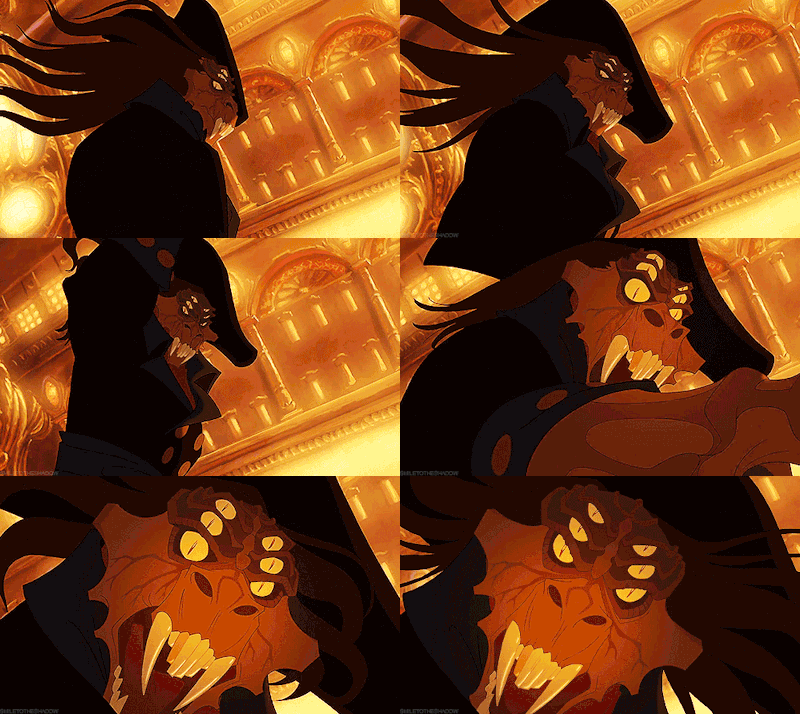
is his fear literal or figurative? does he fear becoming this monster or is this monster representative of all the parts of himself he dislikes/is afraid of? is it humanity vs monstrosity? or is it self vs shadow? is it both?
buckle up, kiddo. you asked for it.
so i believe there’s 3 big ways you can interpret what Jim sees in the Deep: the monster is Jim’s fear, what the monster represents is Jim’s fear, or it’s a combination of the two. from there things branch off. what’s indisputable however is that in some way, shape, or form Jim is afraid of himself, and this is his greatest fear.
the monster is Jim’s fear: if we take it at face value, keeping in mind this is a psychological battle and therefore this monster does not exist outside of Jim, Jim’s fear is becoming the monster. It wears his face, mirrors his movements, and the first time he gets a clear look of it, right before the scene cuts off, he’s terrified by what he sees: himself.
humanity vs monstrosity. heavenly blue vs hellish red. Jim’s human self fighting his monster self, a monster self that does exist in him and looks at least somewhat like what we see, that shows what Jim could potentially be if he’s perhaps not careful.
what the monster represents is Jim’s fear: if we take a more psychological approach, there are multiple ways we can interpret what the monster represents and whether what it represents is consciously or unconsciously known to Jim before the Deep. from this perspective the monster self does not exist in Jim. it’s merely a symbol.
if what the monster represents is consciously known to Jim, because it wears Jim’s face and serves as something dark and frightening, we can say the monster symbolizes one, multiple, or even all of the parts of himself Jim does not like and/or is afraid of. As Richard Siken says,
“Wanna make a monster? Take the parts of yourself that make you uncomfortable – your weaknesses, bad thoughts, vanities, and hungers – and pretend they’re across the room. It’s too ugly to be human. It’s too ugly to be you. Children are afraid of the dark because they have nothing real to work with. Adults are afraid of themselves.”
if what the monster represents is not consciously known to Jim before the Deep, it symbolizes something a little different: the shadow, which can be split between psychological and archetypal interpretations.












 Procrastination Station