cameoappearance:

jumpingjacktrash:

the45thpresidentialruger:

Never talk to me or my 42 trees again

it amuses me to see people being surprised/impressed/amused by this setup, because it’s extremely common on the plains. if you don’t plant a windbreak, your heating and cooling bills are huge, and storms do things like throw the lawnmower through the living room window, take the roof off, or cake the entire north side of the house with six inches of solid ice.

evergreens remain bendy even in the coldest weather, so – wait, no, not the coldest. i remember when i was a kid it got down to like -45 and the norway pines around my house were cracking like gunshots as the sap froze.

maples, incidentally, make that noise around -20f, and i hear it at least once every winter here in southern minnesota. but i only ever heard norway pines make it that one time.

so anyway that’s why we plant pine trees around our houses. because otherwise the wind would freaking kill us.

This is informative and perfectly sensible under the circumstances but I also cannot resist the temptation to compare it to planting stuff all around the boundary of your lot in The Sims
thelibrarina:

squeeful:

zarekthelordofthefries:

acceptableduraz:

zarekthelordofthefries:

Not to critique evolution, but I would think orange and black stripes wouldn’t be as good for camouflage in a forest as, say, green and black would.

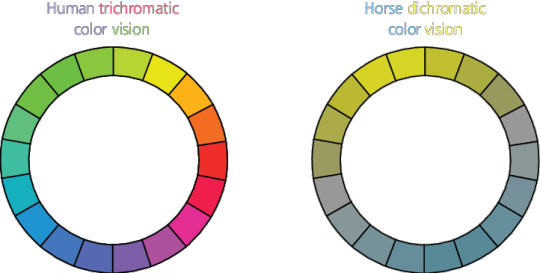
It turns out a lot of animals can’t see the difference between orange and green!  Elephants, for instance, have dichromatic vision (two types of cones, rather than three like most humans.) 

Check out this diagram from ResearchGate.  It deals with the color vision of horses, who are also generally dichromatic.  (I think, though I’m not sure, that zebras would have the same color vision as horses.)  See how orange and green look to them?

Not to critique evolution but I think prey animals should be better at telling when their predator is dressed like a traffic cone.

It doesn’t matter what zebras see, because tigers are not native to Africa and do not naturally hunt zebra.  Tigers are Asian and mostly hunt animals like deer, elk, and buffalo.  These aren’t animals with great color vision.  They don’t need to have it because they don’t eat fruit and so don’t need to know when the berry is ripe vs when it’s not.  Good color vision is too expensive to have if you don’t need it.  Deer put their vision stats in a wide field of vision that is sensitive to motion, low light capabilities, and possibly seeing UV light.  They don’t have great color and lack a lot of acuity, but have a great sense of smell and good hearing.  That’s way more useful if you’re prey.  Deer see well in the blue end of the color spectrum and less well in the red.  This makes sense because deer are most active in the dawn and dusk periods, when there is more blue in the light.  Tigers are taking advantage of deer eyesight by being orange.

We see tigers are being obviously colored because tigers are fruit colored to our tree ape brains.

I don’t know what the best part of this is: implying that deer chose their attributes on a character sheet, or the fact that we get to see tiger colors because they look like a snack.

doktorgun:

blacksquares:

for my entire life i wondered why a dragonfly has an ass thats like 8 times as long as their body and tonight i finally felt compelled to investigate and as it turns out dragonflies breath thru their ass and can shoot water out of their butt hole to make them fly faster…….so…… i really did not expect that to be the answer but there it is

Also: “His copulatory organ is on the underside of his abdomen, up around the second and third segments. His sperm, however, is stored in an opening of his ninth abdominal segment. Before mating, he has to fold his abdomen and transfer his sperm to his penis.” I just imagine like an old-timey single-shot musket being reloaded.